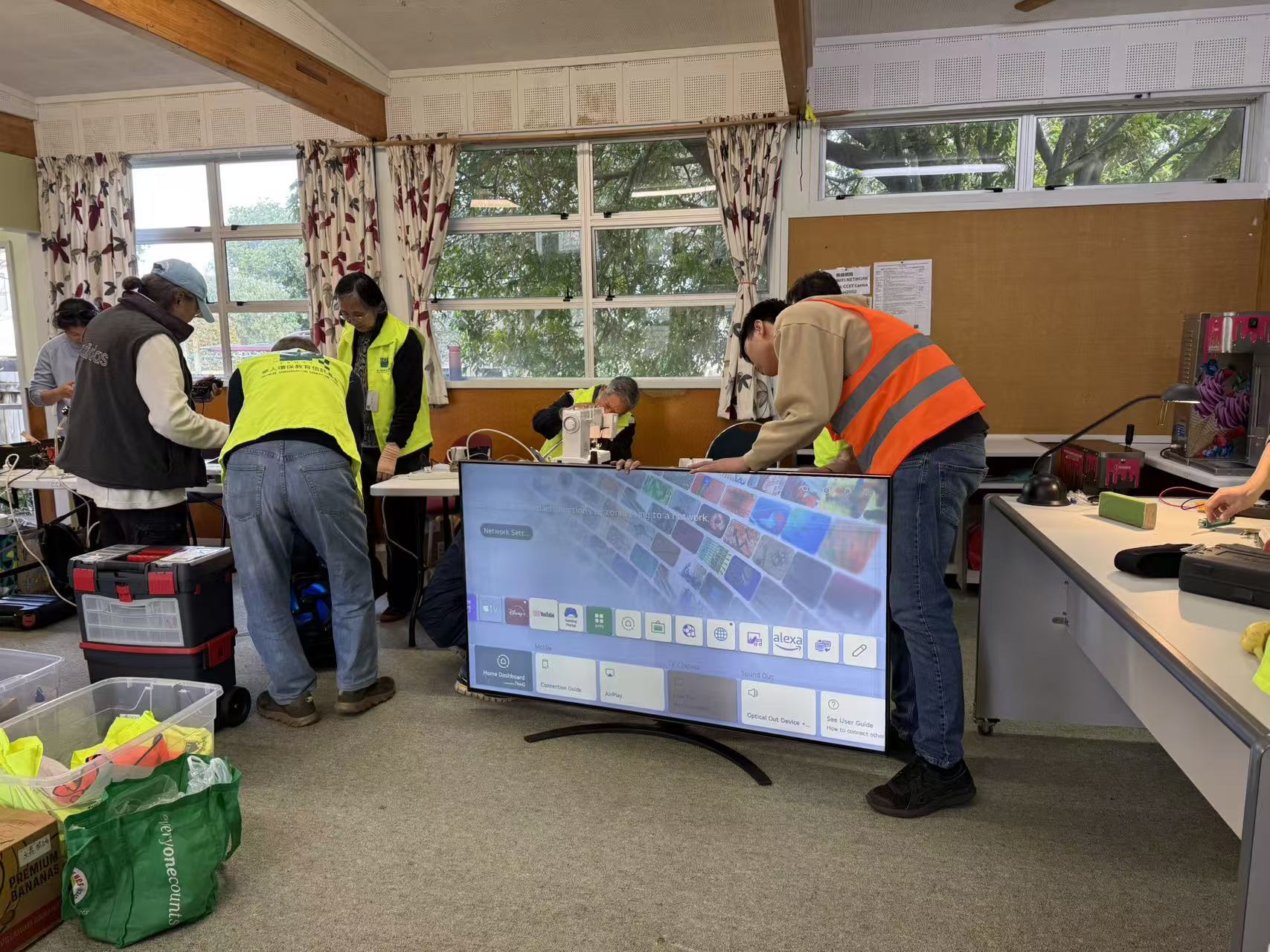
Look at that figure in the bright orange reflective vest in the photo—that’s me, sweating bullets with my CCET (Chinese Environmental Education Foundation) volunteer buddies, huddled around a big TV. That day in the community activity room, sunlight filtered through floral-patterned curtains, and the air smelled like the warm tingle of soldering, the nostalgic scent of old circuit boards, and nonstop laughter from everyone—we were fixing TVs for residents for free.
When I first heard CCET was organizing “community TV repair volunteers,” I was scratching my head: “Why is an environmental foundation branching out into fixing appliances?” Later, I got it—this and “environmental protection” share the same logic: Don’t rush to replace what can be fixed. It saves residents money and cuts down on e-waste. Just like professional repair shops can “bring broken TVs back to life” (as the guide says, “repair over replacement is cheaper and more efficient”), us volunteers wanted to put the idea of “extending the life of old items” into practice through community mutual aid.
The TVs brought in that day were a total “museum-worthy mix”: there was an old CRT TV a Chinese grandma had cherished for over a decade, and an LCD TV with a cracked line from a young person’s move. I learned the ropes from Uncle Zhang, who knew electronics repair. He held a multimeter to test the circuits, saying without looking up: “See this bulging capacitor? It’s exactly like the ‘capacitor failure’ mentioned in the guide—just replace it with a new one. No need to scrap the whole TV.” Jane, a Kiwi volunteer next to us, leaned over too, explaining to a foreign resident in English: “We’re trying to fix it instead of replacing it—better for your wallet and the planet!”
The moment that stuck with me most was with a Chinese grandma. When she carried her old TV over, she kept running her hand over the case: “My son bought this for me before he went abroad—can you save it?” We took off the back cover and found a loose connection in the audio module. After we resoldered it, the TV played her favorite Cantonese opera again. The grandma’s eyes teared up instantly, and she insisted on giving us almond cookies she’d made herself, saying: “You didn’t just fix the TV—you kept my son’s thoughtfulness alive too.” In that second, I suddenly understood: we weren’t just twisting screws—we were retying the emotional bonds between people, and between people and their old things.
Now, when I walk past the community bulletin board and see the feedback notes for “CCET Volunteer Repair Day,” I still can’t help but smile. Someone wrote: “Saved money on a new TV—now I can take my grandson to the zoo one more time!” Another person drew a little picture: a lopsided sketch of our group huddled around a TV. Turns out, “repairing” can really become a little bond in the community—on one side, the warmth of Chinese and local residents helping each other; on the other, the environmental practice of “making the most of what we have and cutting down on waste.”